
For patients considering Septorhinoplasty in London, one of the most common questions is whether an open or closed technique is better. Both approaches can improve the appearance of the nose and, where needed, correct structural problems that affect breathing. The right choice depends on the complexity of the case, the changes required, and the surgeon’s preferred technique.
Understanding the difference between open and closed septorhinoplasty can make the consultation process much easier.
What Is Septorhinoplasty?
Septorhinoplasty combines two procedures:
- Septoplasty, which corrects problems inside the nose, such as a deviated septum
- Rhinoplasty, which reshapes the external appearance of the nose
Patients researching Rhinoplasty in London may be advised to consider septorhinoplasty when cosmetic concerns exist alongside breathing difficulties or internal structural problems.
The procedure can address issues such as:
- A crooked nose
- A dorsal hump
- A drooping or uneven tip
- Nasal asymmetry
- A deviated septum
- Restricted airflow
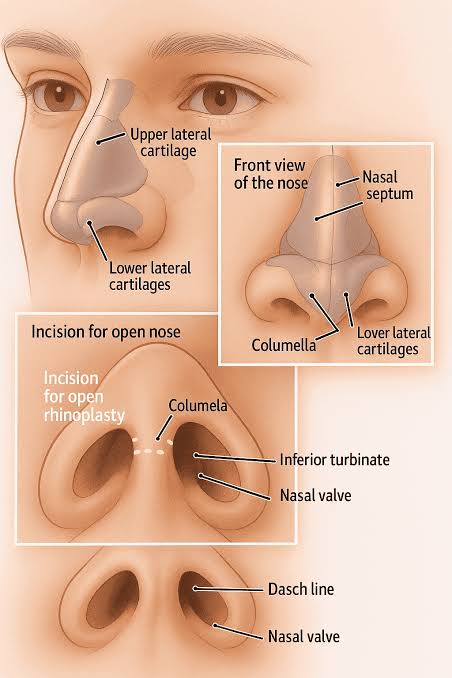
What Is Open Septorhinoplasty?
Open septorhinoplasty uses small incisions inside the nostrils plus a short incision across the columella, which is the strip of skin between the nostrils.
This allows the surgeon to lift the nasal skin and gain a direct view of the underlying cartilage and bone.
Because the internal structures are more visible, the open approach can be useful in complex cases.
It may be considered when the patient needs:
- Major tip reshaping
- Significant asymmetry correction
- Structural grafting
- Revision surgery
- Complex septal correction
For some patients considering Septorhinoplasty in London, this wider surgical view can help the surgeon make more precise structural adjustments.

What Is Closed Septorhinoplasty?
Closed septorhinoplasty is performed through incisions made entirely inside the nostrils.
There is no external incision across the columella.
The surgeon reaches the nasal structures through these internal openings and makes the required changes without lifting the skin in the same way as an open procedure.
Closed surgery may suit patients who need more limited or straightforward corrections.
Possible advantages include:
- No visible external scar
- Less disruption to some nasal tissues
- Potentially less early swelling
- A shorter operation in selected cases
However, it does not automatically mean the procedure is better or easier.
Septorhinoplasty in London: Which Technique Is More Precise?
Precision depends more on the patient’s anatomy and the surgeon’s experience than on the technique alone.
Open septorhinoplasty gives the surgeon a wider view of the nasal framework. This can be useful when several structures need to be changed at the same time.
Closed septorhinoplasty provides less direct exposure, but experienced surgeons can still perform highly accurate work through internal incisions.
For patients exploring Nose Surgery in London, the important question is not simply which method sounds more advanced. It is which method gives the surgeon the best access for the specific corrections required.
When Is the Open Technique Often Preferred?
An open approach may be recommended for more complex surgery.
This can include cases involving:
- Significant tip reshaping
- Severe asymmetry
- Revision rhinoplasty
- Major cartilage reconstruction
- Difficult septal deformities
- Previous nasal trauma
When structural grafts need to be placed carefully, direct visibility can make planning and positioning easier.
Patients undergoing complex Rhinoplasty in London may therefore benefit from the extra access provided by an open approach.
When Might Closed Septorhinoplasty Be Suitable?
Closed surgery may be appropriate when the required changes are more limited.
For example, it may be suitable for:
- Small bridge adjustments
- Minor hump reduction
- Moderate septal correction
- Selected tip changes
- Patients with relatively straightforward anatomy
The absence of an external incision is attractive to some patients, but that should not be the main reason for choosing the technique.
The quality of the final result matters far more than where the incision is placed.
Does Open Septorhinoplasty Leave a Scar?
Open surgery involves a small incision across the columella.
This does leave a scar, but it is usually placed carefully and often becomes much less noticeable as it heals.
Scar appearance varies between patients depending on:
- Skin type
- Healing response
- Aftercare
- Sun exposure
- Individual tendency to scar
Patients considering Septorhinoplasty in London should ask their surgeon to explain where the incision will be and what it is likely to look like during recovery.
Is Recovery Different Between Open and Closed Surgery?
Both techniques involve swelling, bruising, and internal healing.
Closed surgery may cause slightly less swelling in some cases because less tissue is lifted. However, the complexity of the procedure usually has a bigger impact on recovery than the incision type alone.
After either operation, patients may experience:
- Nasal swelling
- Bruising around the eyes
- Congestion
- Temporary numbness
- Tenderness
A splint may be used during the early stage of healing.
Final results from Nose Surgery in London can take several months to become fully visible because nasal swelling reduces gradually.
Can Both Techniques Improve Breathing?
Yes.
If septoplasty forms part of the operation, both open and closed approaches can be used to correct internal structural problems.
This may include treatment of a deviated septum or other issues that restrict airflow.
However, breathing improvement depends on the actual cause of the obstruction.
A cosmetic change alone will not necessarily improve nasal function.
Patients considering Septorhinoplasty in London should clearly explain any breathing symptoms during consultation so the surgeon can assess both function and appearance.
What About Tip Refinement?
The nasal tip is one area where the open approach may offer an advantage in complex cases.
Direct access allows the surgeon to see the tip cartilage clearly and make detailed changes to:
- Projection
- Rotation
- Symmetry
- Definition
- Structural support
However, closed rhinoplasty can also achieve good tip refinement when the changes required are less extensive.
A skilled surgeon experienced in Rhinoplasty in London should be able to explain why one technique is more appropriate for your anatomy.
Does One Technique Give More Natural Results?
Neither technique automatically produces more natural results.
Natural-looking surgery depends on good planning, proportion, surgical restraint, and preservation of important nasal structures.
An over-operated nose can occur with either technique if too much tissue is removed or if the nose is reshaped without considering the rest of the face.
The goal of Nose Surgery in London should be to improve balance while maintaining individual facial character.
Choosing Between Open and Closed Septorhinoplasty
During consultation, the surgeon should assess:
- Nasal shape
- Septal position
- Tip structure
- Skin thickness
- Previous surgery
- Breathing problems
- Desired changes
You should also ask:
- Why do you recommend this technique?
- Will I need cartilage grafts?
- Where will the incisions be?
- How long will swelling last?
- Can my breathing and cosmetic concerns be treated together?
- What results are realistic for my nose?
The choice should be based on anatomy and surgical goals rather than on a general belief that one technique is always superior.
People Also Ask
Is open rhinoplasty better than closed rhinoplasty?
Neither technique is universally better. Open rhinoplasty provides wider access to the nasal framework, which may help in complex cases. Closed rhinoplasty avoids an external incision and may suit more limited corrections. The most appropriate method depends on the patient’s anatomy, treatment goals, and the surgeon’s experience.
Final Thoughts
Both open and closed septorhinoplasty can produce excellent results when used appropriately.
The open technique can offer greater visibility and control for complex structural changes, while the closed approach may be suitable for patients who need more limited corrections.
For anyone considering Septorhinoplasty in London, the most important factor is choosing an experienced surgeon who understands both nasal appearance and breathing function.
London Cosmetic Surgery can assess your nasal structure, symptoms, and goals before recommending the most suitable approach.
Whether you choose open or closed surgery, successful Rhinoplasty in London should focus on balance, function, and natural-looking results rather than simply choosing the technique with the smallest incision.